Skip to content

Starting to run is easy. Carrying on is not.

A plan that reschedules when you miss a day, and steps up or down depending on how it felt. No feed, no kudos, nobody watching.

Download on the App Store Free · iPhone and Apple Watch

iPhone and Apple Watch · No account · No server

Plan screen: the goal, the weeks and the sessions
Today screen: the day's session, the week and the goal
1 in 4
finishes a beginner plan
2nd–5th
the week most people stop

Almost always for the same reason: a progression that was too aggressive, or an injury.

Own Lane is built around that problem.

It asks how it felt

No tracking app does. Your watch measures what you did; this measures what it cost you.

If a session feels easy, the plan steps up sooner. If it flattens you, it drops a step. Progressing more slowly is still progressing.

Today screen: the day's session, the week and the goal

Your days, not the ones you're handed

You mark the days you can actually run and the plan is built on top of them. From walk-and-run all the way to 5K, 10K, a half or a full marathon.

Miss a session and it reschedules onto your next day, respecting the rest you need. The final week drops the volume so you arrive fresh at your goal.

Learn screen: articles with their evidence level
Plan screen: the goal, the weeks and the sessions

Every run, explained

GPS, route map, pace, kilometre splits and cadence.

And then, in plain words: whether you slowed at the end and by how much, whether that's normal, and what to do next time.

Run detail: route map, time, distance and heart rate

What you actually remember

Not the averages or the totals: the first time you last ten minutes. And there is never anyone else on that screen.

Progress screen: minutes running per week

You against you

The milestones, which are what you actually remember: the first time you last ten minutes, your first 5K, your first full month without missing. There is never anyone else on that screen.

The switch ships turned on

Sharing a route is publishing where you live. So hiding your start and finish is not an option you have to go looking for: it comes on by default.

An image you actually want to show

Make a card of your run with the map and the numbers. It comes with a switch, on by default, that hides where you start and finish: sharing a route is publishing where you live.

600km

the kilometres at which almost any midsole already cushions less, and the app tells you

Your shoes, counted

Add the pair you run in and the app counts the kilometres. It warns you when they pass 600, where almost any midsole already cushions less. Without inventing an expiry date nobody has proven.

  • No feed
  • No kudos
  • No followers
  • No account
  • No server
  • No analytics
  • No ads
  • Nobody watching

No social network

Nobody is watching

No feed, no kudos, no followers. Nobody sees what you do unless you decide to share an image. It is built for people who train alone.

The app has no server. No account, no analytics and no tracking: it doesn't contain a single network call. Your runs never leave your phone.

Read the privacy policy →
  • No account
  • No server
  • No analytics
  • Not one network call

What's proven, and what just gets repeated

Every article cites its sources.

See all →
Solid evidence

Cadence: the one technique tweak with backing

Forget about how your foot lands. If you're going to change one thing about your technique, make it shorter, more frequent steps.

5 min read
Solid evidence

Coming back after time off

You lose less than you think and get it back sooner than you fear. What doesn't forgive is picking up where you left off.

5 min read
Solid evidence

The first weeks are the most dangerous

Beginners get injured at more than twice the rate of people who've been at it a while. And the rule everyone repeats to avoid it doesn't work.

6 min read
Solid evidence

Go slower than you think

The number one mistake beginners make isn't training too little: it's running too fast every day.

4 min read
Solid evidence

How long it actually takes to notice you're improving

In the first weeks you improve and can't see it. Knowing when it shows up stops you quitting just before.

4 min read
Solid evidence

Music is the only free trick that works

A little, but measured: you perform slightly better and it costs slightly less. With one condition.

3 min read
Solid evidence

Runner's knee: it hurts at the front, it gets fixed higher up

It's the most common injury when starting out, and what works best isn't done at the knee.

5 min read
Solid evidence

Running in the heat: drink when you're thirsty

The “drink before you're thirsty” rule has put people in hospital. Thirst works.

5 min read
Solid evidence

Two strength days a week

It's the single biggest thing you can do to reduce injury risk. And almost nobody taking up running does it.

5 min read
Reasonable

Rollers, ice and compression: what each one actually does

Almost everything sold as recovery improves how you feel. Whether it recovers you faster is a different question.

5 min read
Reasonable

Why you get a stitch and what to do when it comes

That stab in your side has a name, two out of three runners get it, and some things do work.

4 min read
Reasonable

Sleeping badly injures you more than training too much

It's the part of training you don't train, and the only one you can fix tonight.

4 min read
Reasonable

The pain traffic light: when to stop and when to carry on

“If it hurts, stop” rules out half of rehab. There's a better rule, and it comes from a trial.

5 min read
Unsupported belief

Running fasted doesn't burn more fat overall

You burn more fat during that hour. By the end of the week, the scale hasn't noticed.

4 min read
Unsupported belief

Your first running shoes

They're going to run a gait analysis and recommend shoes based on how you pronate. The evidence that this prevents injuries is far weaker than it looks.

5 min read
Unsupported belief

Nose breathing doesn't make you run better

Breathe however the air comes in. As soon as it gets hard, the mouth wins, and that's fine.

4 min read
Unsupported belief

Asphalt isn't what will injure you

Dirt does cushion more. But when you count actual injuries, the surface doesn't show up.

4 min read
Unsupported belief

Stretching before you run doesn't prevent injuries

We've been doing it forever. Systematic reviews have been saying for years that it doesn't do what we think.

4 min read
Unsupported belief

Stretching doesn't cure soreness

It's been measured many times and the effect is too small to feel. What does help is something else.

4 min read

Apple Watch

On your wrist too

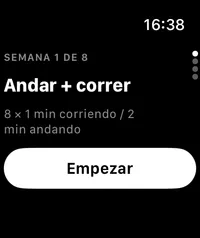
Start, pause and finish from the watch, with a buzz at every interval change.

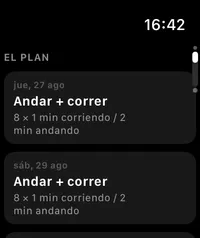
And check your plan, your history and your progress without taking your phone out.

Today's session on Apple WatchThe week's plan on Apple Watch

Free, always

What costs money and what does not

Free

  • The whole plan up to your goal
  • Choosing which days you run
  • Recording your runs with map, splits and cadence
  • The reminders and the history
  • Your milestones and the kilometres on your shoes
  • Sharing a run
  • All of Learn

Own Lane Plus

  • Guided strength twice a week
  • Guided warm-up and cool-down
  • Your bests and the monthly report
  • Your routes compared
  • Race day
  • The interpreted read on every run
  • Heart rate and effort

€49.99 a year, with a 7-day free trial, or €7.99 a month. Cancel any time.

See everything Plus includes →

And the plan will keep adjusting to how you feel, whether you pay or not: charging for what stops you getting injured is something we won't do.

Run from zero, without a feed

Free on the App Store. No account, and nothing leaves your phone.